 CompuCell3D
|
Size: 25204
Comment:
|
Size: 25162
Comment:
|
| Deletions are marked like this. | Additions are marked like this. |
| Line 29: | Line 29: |
| '''Deadline for registration:''' March 31, 2026<<BR>> | '''??<<BR>> |
Welcome to CompuCell3D
NEW CC3D Version 4.8.0 (March 6, 2026)
We are pleased to announce the new version 4.8.0 of our software CompuCell3D. This release includes many new features and several bug fixes. For more details, please visit our Downloads page: Downloads (opens in new tab with Ctrl/Cmd+Click).
Upcoming Competitions and Workshops
2026 Compucell3D Workshop and Hackathon
The 20265 Multicell Virtual-Tissue Modeling Online Summer School and Hackathon has completed! Come learn to model your problem of interest in CompuCell3D.
For information, slide decks, zoom recordings, etc. see 2026 Class page.
Modeling the Invisible: Competition on Forecasting Viral Spread with Limited Data
In this competition workshop, participants will address the challenge of selecting and parameterizing models for complex biological systems. Biological systems present unique hurdles due to their complexity and variability. Even in the face of this complexity, methods to predict the future state of biological systems (and populations) from limited time series data is an ongoing challenge in medical and public heath areas. |
|

Workshop Dates: Wednesday June 3, 2026 - Saturday June 6, 2026 Workshop Dates: Wednesday June 3, 2026 - Saturday June 6, 2026 Location: Georgia State University, Atlanta CA Application Deadline: April 22, 2026 Travel and housing support is available. Deadline for registration: March 31, 2026 Workshop website: Modeling the Invisible Workshop For questions contact: invisibleworkshop@gsu.edu Workshop brochure: Modeling the Invisible Brochure
James Sluka, Indiana University, presentation "Predicting disease with ‘broken’ models, a work in progress" to the IMAG/MSM Viral Pandemics and GLIMPRINT groups Prof. James Glazier (Indiana U.) and Prof. TJ Sego (U. Florida) presentation "Multiscale Multicellular Modeling: Current Challenges and Future Directions" to the Center for Reproducible Biomedical Modeling. Prof. James Glazier's COMBINE 2023 Talk: "Multiscale Muticellular Agent-Based Virtual Tissue Simulations: Challenges and Opportunities in Sharable Virtual Tissue Model Specification". Dr. Juliano Ferrari Gianlupi's COMBINE 2023 Talk: "Breaking Barriers in Multiscale Agent-Based Models: A Path for Cross-Platform Models".
A thirtieth anniversary! Back on March 16th, 1992, François Graner and James Glazier submitted our very first paper on the Cellular Potts Model/Glazier-Graner-Hogeweg model to Physical Review Letters. We had no idea at that point that the method would still be used today and would be implanted in a dozen different modeling frameworks. As of today, that original paper (which appeared on September 28th, 1992) has been cited more than 1350 times.
We collaborate extensively with several other computational biology tools groups. In particular:
Tissue Forge is a continuation of the Mechanica project. The goal of Tissue Forge is to deliver a modeling and simulation framework that lets users from all relevant backgrounds interactively create, simulate and explore models at biologically relevant length scales. We believe that accessible and interactive modeling and simulation is key to increasing scientific productivity, much like how modeling environments have revolutionized many fields of modern engineering.
Mechanica is designed first and foremost to enable users to work interactively with simulations -- so they can build, and run a simulation in real-time, and interact with that simulation whilst it's running. The goal is to create an SolidWorks type environment where users can create and explore virtual models of soft condensed matter physics, with a emphasis towards biological physics.
Tellurium also provides first-class support for exchangeability via COMBINE archives, allowing you to share your models and simulations with other tools.
The invitation to join the IMAG/MSM working group is here.
"A Multiscale Multicellular Spatiotemporal Model of Local Influenza Infection and Immune Response", Sego, T. J., Mochan, E. D., Ermentrout, G. B., & Glazier, J. A. (2021). Journal of theoretical biology, 532, 110918. Full Text "Multiscale Model of Antiviral Timing, Potency, and Heterogeneity Effects on an Epithelial Tissue Patch Infected by SARS-CoV-2", Ferrari Gianlupi J, Mapder T, Sego TJ, Sluka JP, Quinney SK, Craig M, Stratford RE Jr, Glazier JA. Viruses. 2022 Mar 14;14(3):605. doi: 10.3390/v14030605. PMID: 35337012; PMCID: PMC8953050. Full Text
You can run our model in your browser, without any installations, at For more info please visit our CC3D on nanoHUB page.
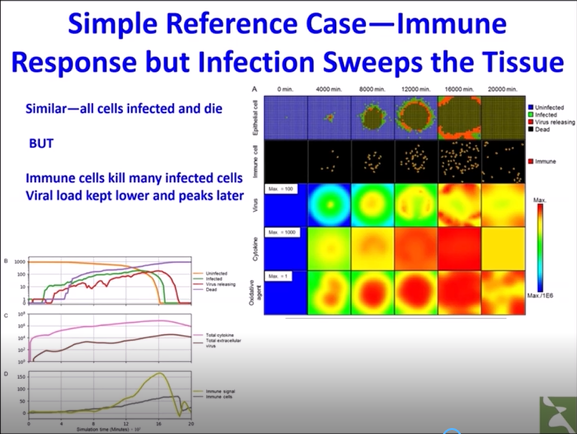
Simulations of tissue-specific effects of primary acute viral infections like COVID-19 are essential for understanding differences in disease outcomes and optimizing therapeutic interventions. In this two-part mini-workshop we present an open-source Python and CC3DML-scripted multiscale model and simulation of an epithelial tissue infected by a virus, a simplified cellular immune response and viral and immune-induced tissue damage and show how you can use it to model basic patterns of infection dynamics and antiviral treatment. Part I presents the model and teaches how to run it and to change model parameters for generating new biologically meaningful simulations. Part II teaches how to extend the model with additional images, graphics and file outputs, additional cell types, diffusive fields, cell behaviors and interactions and improved subcellular and immune-system models. For more info and scheduling see here. The Part I and Part II videos are now available on YouTube. We have prepared a YouTube video describing the model described in our preprint.
This is a more detailed video presentation hosted by the Pacific Institute for the Mathematical Sciences on the use of CC3D in Covid-19 modeling.
The rapidly evolving social and medical impact of COVID-19 requires equally rapid development of tools to predict, and ultimately ameliorate, the future course of the pandemic. Tools are needed to predict patient outcomes, to optimize the deployment of resources by medical providers, and to optimize therapy for infected individuals. Predictive computational simulations of the spread of the disease, and of the underlying biology that makes COVID-19 unique, are both essential. Our aim is to build cooperatively-developed, open-source multiscale model components that can predict various aspects of infection at molecular and tissue scales and inform higher-level models, and a framework to allow others to do so efficiently. You can run our model online without any installations in Model documentation and simulation files can be found in the project folder of our COVID-19 Model Repository. Please be advised that this is a rapidly evolving project, so model and simulation features are subject to change (even daily). For more information about how to contribute to, modify, or reuse the model and simulation, please contact us at <tjsego AT iu DOT edu>. For information on recent modeling and repository developments, current development plans, and opportunities to contribute to current modeling and repository projects, please see our project page.
CompuCell3D is available for online use on nanoHUB. Some CompuCell3D simulations are already available as demonstrations. See the CC3D on nanoHUB page for more info.
CompuCell3D is a flexible scriptable modeling environment, which allows the rapid construction of sharable Virtual Tissue in silico simulations of a wide variety of multi-scale, multi-cellular problems including angiogenesis, bacterial colonies, cancer, developmental biology, evolution, the immune system, tissue engineering, toxicology and even non-cellular soft materials. CompuCell3D models have been used to solve basic biological problems, to develop medical therapies, to assess modes of action of toxicants and to design engineered tissues. CompuCell3D's intuitive interface makes Virtual Tissue modeling accessible to users without extensive software development or programming experience. It uses Cellular Potts Model to model cell behavior. Below is a preview of what CC3D can do:
This project is currently funded by generous support from the U.S. National Science Foundation (NSF) grant NSF-1720625, “Network for Computational Nanotechnology - Engineered nanoBIO Node” and National Institute of Health, National Institute of Biomedical Imaging and Bioengineering (NIBIB) Grant U24EB028887, "Dissemination of libRoadRunner and CompuCell3D".
U.S. National Institutes of Health (NIH) grant NIH - R01 GM122424, “Competitive Renewal of Development and Improvement of the Tissue Simulation Toolkit”. Information on previous support is listed on our Support page. CompuCell3D is led by James A. Glazier (Indiana Univ) in collaboration with Dr. David Umulis (Purdue Univ). Many people contribute, or have contributed, to CC3D including the original lead developer Maciej Swat.
To report any bugs, or to ask questions, please visit our Q&A page:
We highly encourage fellow researchers to contribute to CompuCell3D code. If you have developed some useful plugin or functionality on CompuCell3D and would like share it with rest of us. Please commit the code and open a pull request on CompuCell3D GitHub repository. We would love to see it in next version of CompuCell3D.
Multi-Scale Modeling of Tissues Using CompuCell3D – M. Swat, Gilberto L. Thomas, Julio M. Belmonte, A. Shirinifard, D.Hmeljak, J. A. Glazier, Computational Methods in Cell Biology, Methods in Cell Biology
For a more complete list see our Publication Page. A Multiscale Spatial Modeling Framework for the Germinal Center Response. Programming Juxtacrine-Based Synthetic Signaling Networks in a Cellular Potts Framework A Cellular Potts Model of the interplay of synchronization and aggregation Shape-velocity correlation defines polarization in migrating cell simulations CompuCell3D simulations reproduce mesenchymal cell migration on flat substrates. Fibroblast state switching orchestrates dermal maturation and wound healing Computational Model of Secondary Palate Fusion and Disruption Spheroid Formation of Hepatocarcinoma Cells in Microwells: Experiments and Monte Carlo Simulations A Liver-Centric Multiscale Modeling Framework for Xenobiotics Dynamics of cell aggregates fusion: Experiments and simulations Synergy of cell–cell repulsion and vacuolation in a computational model of lumen formation Advances in Modelling of Epithelial to Mesenchymal Transition
Location: Georgia State University, Atlanta CA
Application Deadline: April 22, 2026
Travel and housing support is available.
??
Workshop website: Modeling the Invisible Workshop
Workshop brochure: Modeling the Invisible Brochure
For questions contact: invisibleworkshop@gsu.edu
New Seminars available on Multiscale Modeling with Compucell3D
30 Years!
https://journals.aps.org/prl/abstract/10.1103/PhysRevLett.69.2013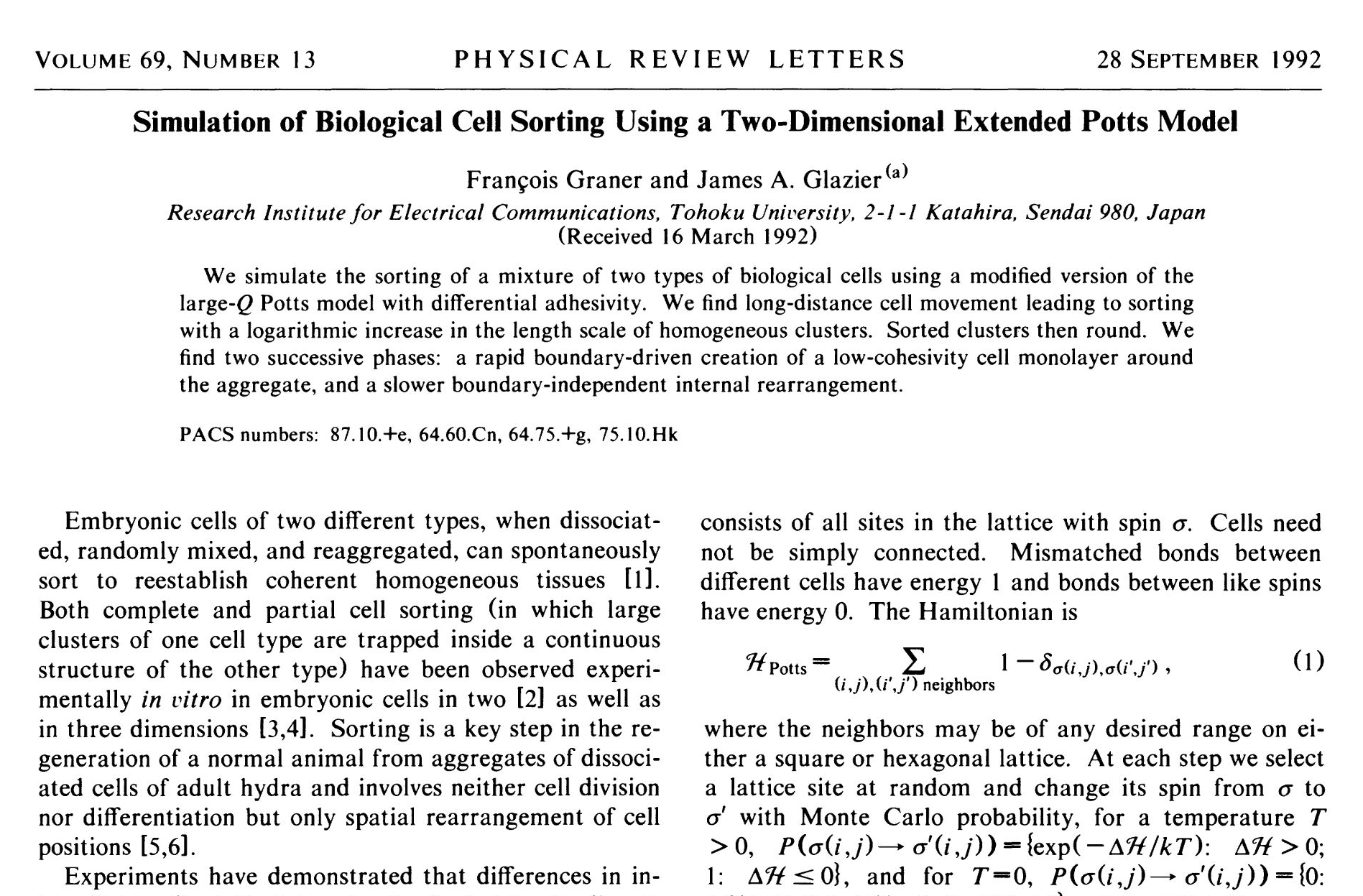
Our Collaboratory Projects
Tissue Forge
Mechanica
 Mechanica is an interactive particle based physics, chemistry and biology simulation environment, with a heavy emphasis on enabling users to model and simulate complex sub-cellular and cellular
 Tellurium
 Tellurium allows you to model, simulate, and analyze
 Invitation to join the IMAG/MSM MULTISCALE MODELING AND VIRAL PANDEMICS Working Group
NEWS: We have viral infection model papers!
NEWS: Our Covid-19 virtual tissue model is available for running on nanoHUB!
 (here).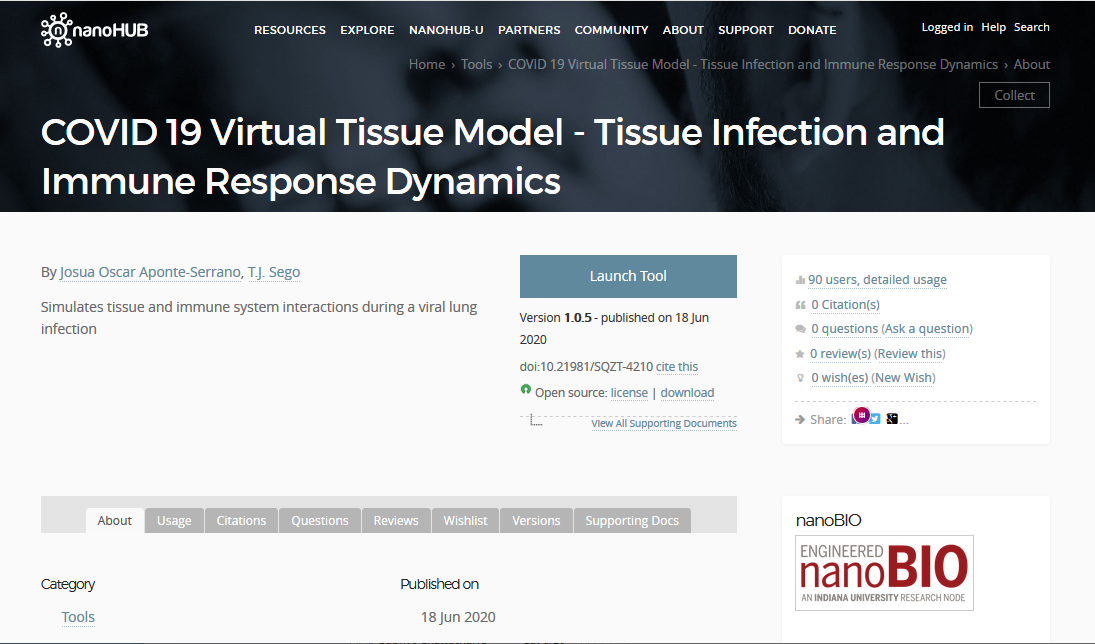
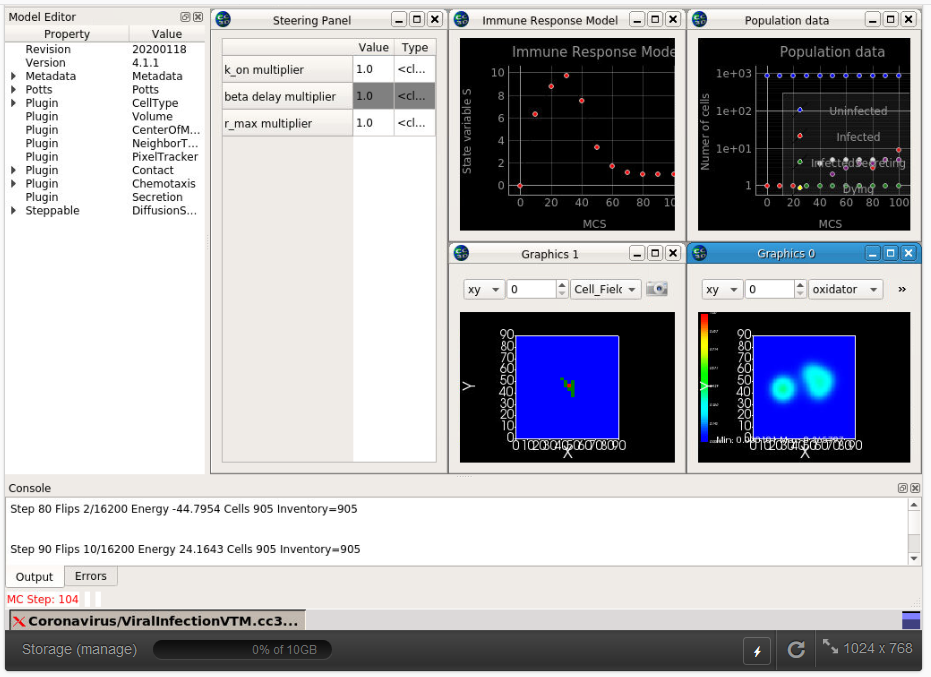
NEWS: CompuCell3D Multiscale, Virtual-Tissue Spatio-Temporal Modeling of Simulations of COVID-19 Infection, Viral Spread and Immune Response and Treatment Regimes
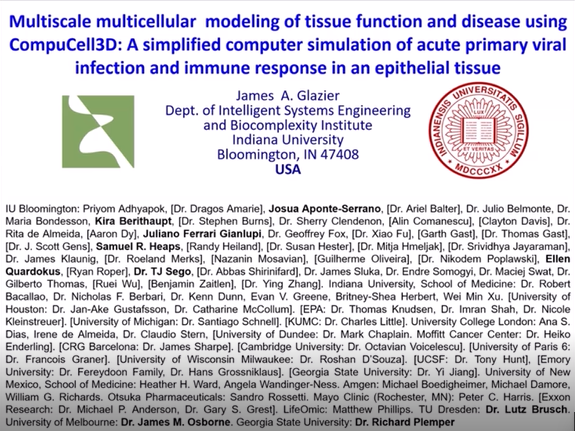
Multiscale multicellular modeling of tissue function and disease using CompuCell3D: A simplified computer simulation of acute primary viral infection and immune response in an epithelial tissue
(Click on this image to view the video.)
Call to Contribute: Collaborative Tissue Model Development to Mitigate the Coronavirus Pandemic

CompuCell3D on ...

About CompuCell3D


Support
Past support for this project includes:
New CC3D forum
Want to contribute to CompuCell3D development?
How to cite CompuCell3D
New Papers using CompuCell3D Simulations have been published:
Follow us on social media and other sites



 CompuCell3D code at